
In our culture of overnight success obsessions and the endless “30 under 30” lists, it’s easy to feel like life is just a linear countdown to the end. We often operate under the assumption that if we haven’t reached a certain milestone by a certain age, the opportunity has simply passed us by, that our trajectory is fixed, our fuel is spent, and our best years are in the rearview mirror.
But, lucky for us, the universe doesn’t actually work that way.
The defiers of time
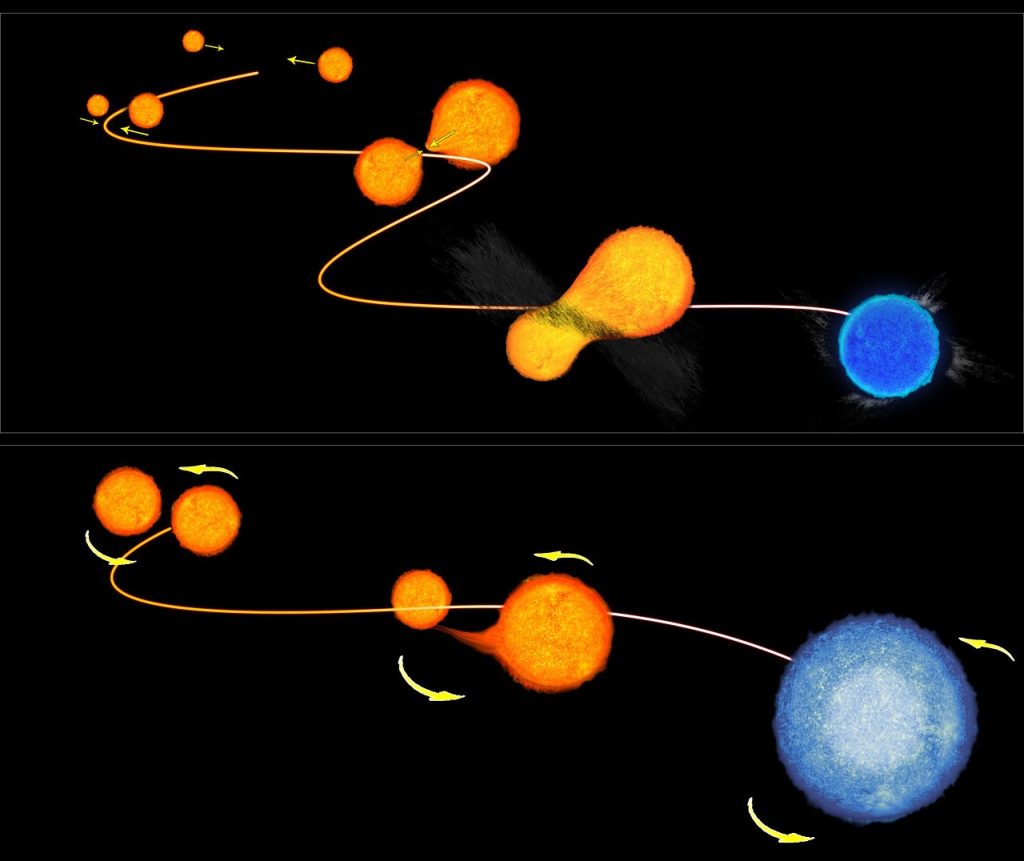
According to a 2026 study from the Hubble Space Telescope (heic2602), there is a specific type of star that has been baffling astronomers for over 70 years by doing the “impossible”: starting over. They’re called blue stragglers, and they are some pretty rad cosmic outliers.
In an ancient star cluster, the rules of aging are usually strict and straightforward. All the stars were born at the same time, from the same cloud of gas. As they age, they should all follow a predictable path, turning red and dim as they run out of hydrogen.
Yet, right in the middle of these “retired” clusters, astronomers found stars that are hotter, bluer, and look significantly younger than their star-siblings. They “straggle” behind the expected aging process, effectively resetting their internal clocks.
For a long time, we thought these stars were the result of violent, rare collisions, essentially a cosmic “car crash” that forced two stars together. But Hubble’s latest data suggests something much more subtle and, frankly, much more hopeful for those of us navigating our own resets.
The power of the “slow siphon”
Most blue stragglers aren’t born from a singular, traumatic impact. Instead, they thrive through binary partnerships.
In a binary system, two stars orbit one another. Over eons, the blue-straggler-to-be slowly “siphons” fresh hydrogen from its companion. It’s not a sudden explosion; it’s a steady, rhythmic transfer of energy. This new fuel allows the star to reignite, burning hotter and brighter than it ever could have on its own.
I think what we could learn from these brilliant blue fellas is that a fresh start doesn’t have to be a total demolition of your past. We don’t have to burn it all down to start over. Often, a fresh start is about finding a new source of “fuel”, maybe a new friend, a new perspective, or a new passion, etc., that allows you to reintegrate your existing awesomeness into something brighter and, well, awesomer.
The case for the “quiet cluster”
I think the most interesting part of the Hubble discovery is where these stars are most successful.
You might assume that the most crowded, high-energy parts of a galaxy would be the best places to find these rejuvenated stars. More stars, more chances, right? But the data shows the exact opposite: blue stragglers thrive in low-density environments.
In densely packed “busy” clusters, the constant gravitational interference from too many neighbors actually breaks binary pairs apart. The stars are so crowded and bumped by the chaos around them that they don’t have the stability to form the partnerships required for the transfer.
They need space. They need a “quiet neighborhood” where they aren’t constantly being jostled by the orbits of everyone else around them. I mean, who couldn’t relate to that?!
Your orbit, your timeline
If you’re feeling behind or like you’ve missed your window to shine, try taking some tips from the sky.
Are you in an environment so crowded with other people’s expectations and hustle that you can’t hear your own thoughts? What is providing you with fresh energy? Is it a deep dive into a new interest? A supportive friend? A quiet morning routine?
There is no rule that says you have to age, grow, or succeed at the same rate as the stars born in your same cluster.
The blue straggler proves that youth is a state of energy, not just a date on a calendar, and sometimes, the best way to start over isn’t to, you know, explode. It’s to move to somewhere quieter, find a steady source of fuel, and let your internal clock set its own pace.
Stay curious. Stay kind. And remember: the universe is literally designed for second acts.
Did you enjoy this article? Check out the Propagating Self-Love newsletter for more!